
Liderlar Online20 daqiqa
Artificial Intelligence And Digital Technologies For The Preservation And Modernization Of Uzbek National Costume Heritage
Preserving Uzbek Traditional Fashion Through Artificial Intelligence, 3D Modeling and Digital Heritage Technologies Nusxalash
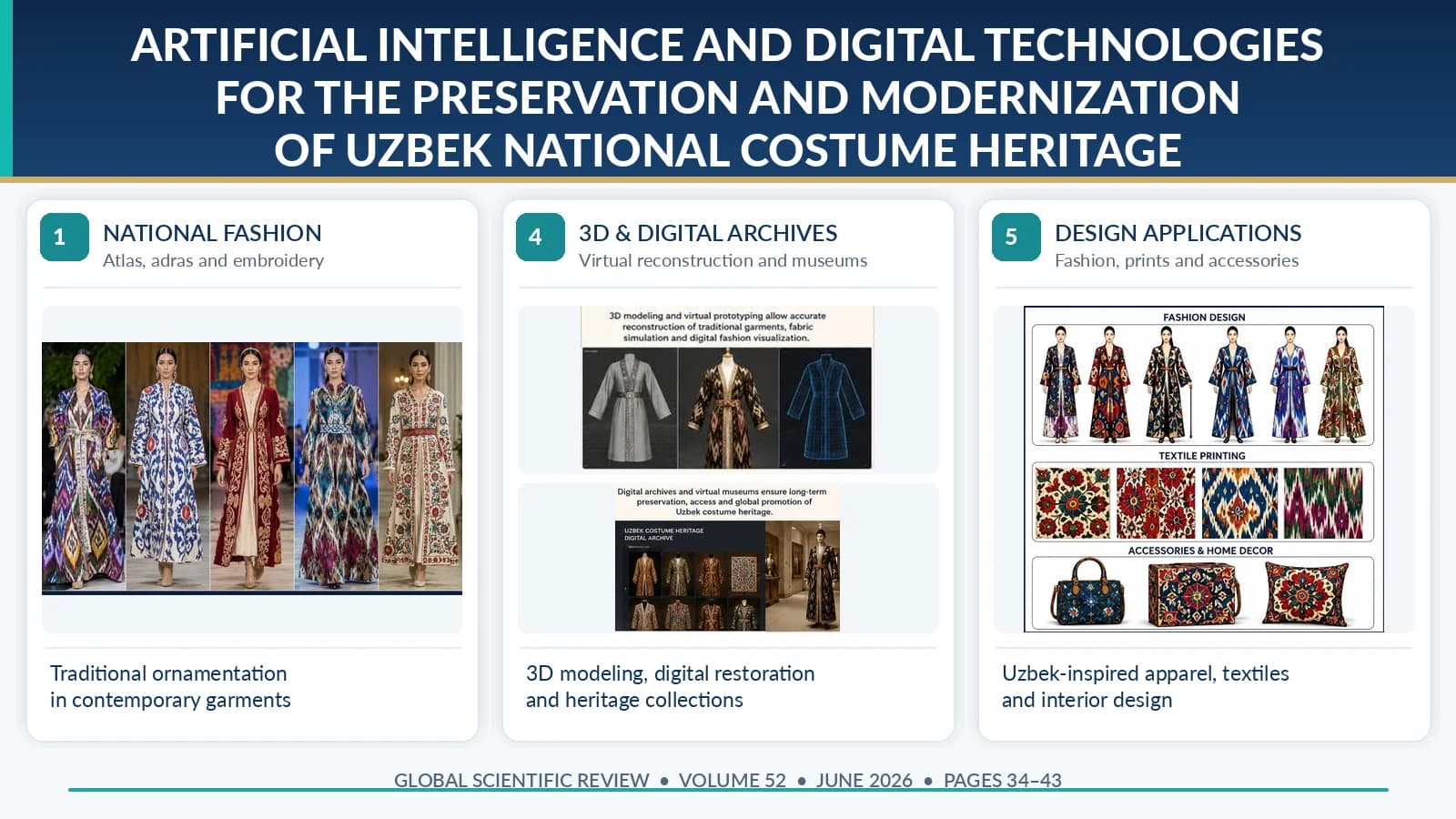
ARTIFICIAL INTELLIGENCE AND DIGITAL TECHNOLOGIES FOR THE PRESERVATION AND MODERNIZATION OF UZBEK NATIONAL COSTUME HERITAGE
Marjona Valijon qizi Alikulova
First-Year Student, Fashion Design Program
Tashkent International University of Chemical Technologies (KIUT), Uzbekistan
Scientific Supervisor: Bakhodir Kholmirzaevich Eshmamatov
Abstract
This study investigates the role of artificial intelligence and digital technologies in the preservation, digitalization, and modernization of Uzbek national costume heritage. The research examines the application of machine learning, computer vision, generative artificial intelligence, digital archiving, and three-dimensional modeling technologies for documenting, analyzing, reconstructing, and promoting traditional Uzbek garments. A qualitative comparative and analytical approach was employed to evaluate the effectiveness of AI-assisted digital platforms in preserving traditional patterns, embroidery motifs, textile structures, and costume designs. The findings indicate that artificial intelligence technologies significantly improve the efficiency of cultural heritage documentation, facilitate the creation of virtual costume collections, and support the integration of traditional design elements into contemporary digital fashion products. Furthermore, AI-powered solutions contribute to virtual exhibitions, digital museums, personalized fashion design, and sustainable cultural development. The study concludes that the integration of artificial intelligence with digital fashion technologies creates new opportunities for safeguarding national identity while enhancing innovation and global accessibility of Uzbek cultural heritage.
Keywords: artificial intelligence, digital technologies, Uzbek national costume, cultural heritage, digitalization, machine learning, computer vision, digital fashion, 3D modeling.
Аннотация
В данной статье исследуется роль искусственного интеллекта и цифровых технологий в сохранении, цифровизации и модернизации узбекского национального костюма как важного элемента культурного наследия. Рассматриваются возможности применения машинного обучения, компьютерного зрения, генеративного искусственного интеллекта, цифрового архивирования и технологий трёхмерного моделирования для документирования, анализа, реконструкции и популяризации традиционной узбекской одежды. На основе сравнительного и аналитического подходов проведена оценка эффективности цифровых платформ, использующих технологии искусственного интеллекта для сохранения национальных орнаментов, вышивки, текстильных структур и конструктивных особенностей костюма. Результаты исследования показывают, что технологии искусственного интеллекта способствуют повышению эффективности цифрового документирования культурного наследия, созданию виртуальных коллекций одежды и интеграции традиционных элементов дизайна в современные
цифровые модные продукты. Кроме того, интеллектуальные технологии расширяют возможности виртуальных выставок, цифровых музеев, персонализированного дизайна одежды и устойчивого культурного развития. Сделан вывод о том, что интеграция искусственного интеллекта и цифровых технологий моды создаёт новые возможности для сохранения национальной идентичности, развития инноваций и повышения международной доступности культурного наследия Узбекистана.
Ключевые слова: искусственный интеллект, цифровые технологии, узбекский национальный костюм, культурное наследие, цифровизация, машинное обучение, компьютерное зрение, цифровая мода, трёхмерное моделирование.
Introduction
The rapid development of artificial intelligence (AI) and digital technologies has significantly transformed various sectors of society, including education, healthcare, industry, and the creative economy. In recent years, these technologies have also become important tools for the preservation, documentation, and promotion of cultural heritage. Artificial intelligence, machine learning, computer vision, digital archiving, and three-dimensional (3D) modeling technologies provide new opportunities for recording, analyzing, reconstructing, and disseminating cultural artifacts in digital environments. [7,8]
Cultural heritage preservation has become one of the major challenges of the digital era. Traditional clothing represents not only a material product but also a valuable expression of a nation’s historical memory, cultural identity, artistic traditions, and social values. Uzbek national costume is an important component of the country’s rich cultural heritage and reflects centuries of craftsmanship, textile production, embroidery techniques, and regional artistic diversity. Traditional garments decorated with suzani embroidery, atlas and adras fabrics, and unique ornamental motifs embody significant historical and cultural knowledge that should be preserved for future generations. [9,10,13,14]
Globalization and the rapid expansion of contemporary fashion trends have influenced clothing preferences worldwide, resulting in a gradual decline in the everyday use of traditional garments. Many authentic examples of Uzbek national costume are currently preserved only in museums, archives, and private collections, making them less accessible to researchers, designers, and the general public. Consequently, there is a growing need for innovative digital solutions capable of preserving and promoting this cultural heritage in sustainable and accessible forms. [1,4,17]
Artificial intelligence technologies offer effective mechanisms for addressing these challenges. Computer vision systems can automatically recognize and classify traditional patterns, embroidery motifs, and textile structures. Machine learning algorithms can assist in analyzing historical costume data, while generative AI tools can support the creation of new fashion concepts inspired by traditional Uzbek designs. In addition, 3D modeling and virtual reality technologies enable the reconstruction of historical garments and the development of virtual costume collections, digital museums, and interactive exhibitions. [1,8,18]
The integration of artificial intelligence with digital fashion technologies has created new possibilities for preserving cultural heritage while simultaneously supporting innovation within the fashion industry. These technologies facilitate digital archiving, virtual visualization, personalized design solutions, and global access to cultural
resources. As a result, traditional design elements can be effectively adapted to contemporary fashion products without losing their cultural authenticity and historical significance. [7,8,17,18]
The purpose of this study is to investigate the role of artificial intelligence and digital technologies in the preservation, digitalization, and modernization of Uzbek national costume heritage. The research also evaluates the potential of AI-assisted solutions for documenting traditional costume elements, supporting cultural sustainability, and promoting Uzbek national heritage within contemporary digital fashion environments. Artificial Intelligence Applications in the Preservation and Modernization of Uzbek National Costume Heritage Artificial intelligence (AI) and digital technologies have become powerful tools for preserving and modernizing cultural heritage in the digital era. In the context of Uzbek national costume heritage, AI can support the documentation, analysis, restoration, digitalization, and promotion of traditional garments, ornaments, and textile patterns. [1,4,7]
One of the most important applications of AI is computer vision technology. Computer vision systems can automatically identify and classify traditional Uzbek ornamental motifs, embroidery elements, textile structures, and color compositions from digital images. Such technologies enable the creation of large-scale digital databases of atlas, adras, suzani embroidery, and other traditional textile products. Automated image recognition significantly reduces the time and effort required for manual documentation and cataloging. [10,13,14,18]
Machine learning algorithms can analyze large collections of historical costume data and identify similarities, regional characteristics, stylistic variations, and design features among traditional garments. These analytical capabilities help researchers better understand the evolution of Uzbek national costume and contribute to the preservation of valuable cultural knowledge. [4,17]
Generative artificial intelligence provides new opportunities for innovation in contemporary fashion design. By learning from historical patterns and traditional design elements, AI systems can generate modern clothing concepts inspired by Uzbek cultural heritage. Such technologies allow designers to create contemporary fashion products while preserving the authenticity, artistic identity, and symbolic value of traditional ornaments. [1,2,12,17]
Three-dimensional (3D) modeling and digital twin technologies further contribute to heritage preservation by enabling the reconstruction of historical garments in virtual environments. Digital costume models can be used in museums, educational platforms, virtual exhibitions, and digital fashion collections. These solutions increase public access to cultural heritage and facilitate international cultural exchange. [7,8,15]
In addition, AI-powered digital archives support the long-term preservation of textile heritage by organizing, managing, and analyzing large volumes of cultural data. Virtual reality (VR) and augmented reality (AR) technologies enhance user engagement by allowing visitors to interact with digital representations of traditional Uzbek costumes in immersive environments. [7,8,15]
Furthermore, AI-supported digital platforms contribute to the promotion of Uzbek national costume heritage through virtual exhibitions, online archives, personalized fashion design solutions, and digital fashion ecosystems. These innovations strengthen cultural sustainability and increase international awareness of Uzbekistan’s rich artistic and textile traditions. [8,15,17,18]
Therefore, the integration of artificial intelligence and digital technologies creates innovative opportunities for preserving, modernizing, and promoting Uzbek national costume heritage while ensuring the continuity of cultural identity for future generations.
Figure 1. Artificial Intelligence and Digital Technologies in the Preservation and Modernization of Uzbek National Costume Heritage The figure presents a collection of contemporary fashion garments inspired by the rich cultural heritage of Uzbek national costumes. The designs demonstrate how traditional decorative elements, textile patterns, and ornamental motifs can be successfully integrated into modern fashion while preserving their historical and cultural significance. [1,4,7,17]
The garments showcase a harmonious combination of traditional craftsmanship and contemporary design approaches, reflecting the ongoing transformation of national heritage within the modern fashion industry. [1,10,12,17] A prominent feature of the collection is the use of traditional Uzbek textiles and ornamentation. Several garments incorporate ikat-inspired patterns characteristic of atlas and adras fabrics, which are among the most recognizable textile traditions of Uzbekistan. These fabrics are known for their vibrant colors, dynamic geometric forms, and distinctive visual effects created through the ancient ikat dyeing technique. The bold and expressive patterns contribute to the uniqueness of the garments while preserving an important element of national identity. [9, 13,16,19]
AI and Digital Fashion Applications in Uzbek National Costume Preservation.The rapid development of artificial intelligence and digital technologies has created new opportunities for the preservation, documentation, and modernization of traditional cultural heritage. In the field of fashion design, these technologies have become valuable tools for protecting national identity while simultaneously supporting innovation and creative development. [1,4,7,8]
[Figure 1: Uzbek-inspired national fashion garment collection — see supplied figure file]
Uzbek national costumes, characterized by their rich ornamental traditions, distinctive textile patterns, and symbolic decorative elements, represent an important component of the country's cultural heritage. [9,10,11,19]
The integration of artificial intelligence, digital fashion technologies, three- dimensional modeling, and digital archiving systems enables designers, researchers, and cultural institutions to preserve historical knowledge while adapting traditional elements to contemporary fashion requirements. [1,4,8,17]
Through advanced digital tools, traditional motifs can be analyzed, reconstructed, visualized, and incorporated into modern garments without losing their cultural authenticity. As a result, artificial intelligence and digital fashion technologies contribute not only to the protection of cultural heritage but also to its sustainable development and global promotion. [1,2,15,17,18]
Figure 4. 3D Modeling, Digital Archives, and Virtual Museums for the Preservation of the Uzbek National Costume Heritage The figure illustrates the application of advanced digital technologies in the preservation and modernization of Uzbek national costume heritage. It demonstrates how 3D modeling, virtual prototyping, digital archives, and virtual museums contribute to the documentation, reconstruction, and global promotion of traditional garments and ornamental traditions. [7,8,15,17]
The left section of the figure presents the process of three-dimensional modeling and virtual garment reconstruction. It shows a traditional Uzbek costume represented in three stages: an initial digital model, a fully textured garment featuring traditional atlas and adras-inspired patterns, and a wireframe model used for technical visualization and garment simulation. Technologies such as CLO 3D, Marvelous Designer, and Blender enable designers and researchers to recreate historical garments with high accuracy, analyze construction techniques, and simulate fabric behavior in a virtual environment. These tools support both cultural preservation and sustainable fashion development by reducing the need for physical prototypes. [1,4,8,15,18]
AI-Assisted Design Development. Artificial intelligence has emerged as a transformative technology in contemporary fashion design, offering innovative approaches to the creation and adaptation of traditional ornamental motifs. AI- powered image generation platforms such as Midjourney, DALL·E, and Stable Diffusion enable designers to explore new interpretations of Uzbek national ornamentation while maintaining connections to historical artistic traditions. These systems utilize machine learning algorithms trained on extensive visual datasets, allowing them to generate unique design concepts based on textual descriptions and visual references. [1,2,4]
[Figure 4: 3D modeling, digital archives and virtual museums — see supplied figure file]
In the context of Uzbek national costume heritage, AI-assisted design development provides opportunities for the digital reinterpretation of traditional decorative elements found in atlas and adras fabrics, suzani embroidery, and historical textile collections. Designers can input descriptions of traditional motifs and receive multiple design variations that combine cultural heritage with contemporary fashion aesthetics. This process significantly accelerates creative experimentation and expands the range of potential design solutions. [10, 14,17,18]
Generative artificial intelligence also supports ornament generation by identifying visual relationships between traditional motifs and producing innovative compositions inspired by historical patterns. Through this approach, designers can preserve essential cultural characteristics while adapting decorative elements to modern silhouettes, textile surfaces, and fashion products. AI-generated ornamentation can be applied to clothing, accessories, digital fashion assets, and textile prints, providing new opportunities for the commercialization and international promotion of Uzbek cultural heritage. [1,4,15,17,18]
Furthermore, artificial intelligence contributes to design efficiency by reducing the time required for concept development and visualization. Designers can rapidly evaluate multiple creative alternatives, compare stylistic variations, and refine ornament compositions before entering the production stage. As a result, AI-assisted design development represents a valuable tool for balancing cultural preservation with innovation in contemporary fashion design. [1,2,4]
Figure 5. Modern Applications of Uzbek Traditional Ornamentation in Fashion and Interior Design [Figure 5 image: contemporary fashion, textile printing, and accessories & home decor]
The image presents a collection of contemporary design products inspired by traditional Uzbek textile and ornamental heritage. The collection consists of a women's dress, a handbag, and a decorative pillow, all featuring patterns derived from Uzbek national artistic traditions. These products demonstrate how traditional cultural elements can be successfully integrated into modern fashion and interior design while preserving their aesthetic and symbolic significance. [10,12,15,17]
The dress showcases a vibrant ikat-inspired pattern commonly associated with traditional Uzbek atlas and adras textiles. Ikat fabrics have been produced in Central Asia for centuries and are recognized for their distinctive blurred geometric motifs created through a complex resist-dyeing technique. The colorful composition of blue, purple, white, green, and yellow tones reflects the rich visual language of Uzbek textile art. By adapting these traditional patterns to a contemporary garment silhouette, designers create fashion products that combine cultural heritage with modern elegance and functionality. [9,10,11,13,16,19]
3D Modeling of Uzbek National Costumes. Three-dimensional modeling technologies have become essential instruments for the digital preservation and
[Figure 5: Modern Uzbek ornamentation in fashion and interior design — see supplied figure file]
visualization of traditional clothing. Software platforms such as CLO 3D, Marvelous Designer, and Blender enable the creation of highly detailed virtual garments that accurately represent the structure, materials, and decorative features of historical costumes. These technologies facilitate the preservation of cultural heritage by producing digital replicas that can be studied, archived, and displayed without exposing original artifacts to physical deterioration. [1,7,8,17]
CLO 3D is widely used in the fashion industry for garment simulation and virtual prototyping. The software allows designers to create realistic digital representations of Uzbek national garments, including traditional dresses, robes, and ceremonial clothing. Fabric properties, embroidery details, and ornamental patterns can be accurately simulated, providing a realistic visualization of how garments appear and behave in real-world conditions. [1,4,18]
Marvelous Designer offers advanced garment construction capabilities and realistic fabric simulation. Through this technology, historical Uzbek costumes can be recreated based on archival photographs, museum collections, and ethnographic documentation. Designers can analyze garment structures, evaluate pattern construction methods, and visualize historical clothing from multiple perspectives.[4,10,17]
Blender provides additional opportunities for cultural heritage visualization through advanced rendering, animation, and virtual environment development. Digital models of traditional costumes can be integrated into virtual museums, educational platforms, and interactive exhibitions. These applications enhance public access to cultural heritage while supporting academic research and fashion education. [7,8,15,17]
The use of three-dimensional modeling technologies also contributes to sustainable fashion practices. Virtual prototyping reduces material waste by allowing designers to test concepts digitally before producing physical samples. Consequently, 3D modeling serves both cultural preservation and environmental sustainability objectives within contemporary fashion development. [1,4,8,17]
Digital Archives and Virtual Museums. Digital archives and virtual museums play a critical role in preserving cultural heritage for future generations. Traditional textile collections, historical garments, embroidery samples, and ornamental motifs are vulnerable to deterioration caused by environmental conditions, handling, and the passage of time. Digital preservation technologies provide effective solutions for documenting and safeguarding these valuable cultural resources. [7,8,15]
Digital archives enable the systematic collection, organization, and storage of visual and textual information related to Uzbek national costume heritage. High-resolution photographs, three-dimensional scans, historical documents, and ethnographic records can be integrated into comprehensive heritage databases accessible to researchers, designers, educators, and cultural institutions. Such databases facilitate knowledge sharing and support interdisciplinary collaboration in the fields of fashion, history, anthropology, and cultural studies. [7,10,15,17]
Virtual museums extend the accessibility of cultural heritage beyond geographical boundaries. Through digital platforms, users from different countries can explore collections of Uzbek national costumes, examine ornamental details, and learn about traditional textile production techniques. Interactive features, virtual tours, and augmented reality applications enhance user engagement and provide immersive educational experiences. [7,8,17,18]
Online collections also contribute to the promotion of cultural tourism and international cultural exchange. By presenting traditional costumes through modern
digital technologies, cultural institutions can attract wider audiences and increase awareness of Uzbekistan’s artistic heritage. The integration of artificial intelligence further enhances digital preservation by enabling automated cataloging, image classification, and pattern recognition processes. [1,7,8,17,18]
As digital technologies continue to evolve, virtual museums and digital archives are expected to become increasingly important tools for preserving, studying, and promoting traditional cultural heritage in the digital age. [7,8,17]
Case Studies of AI-Based Reconstruction. Artificial intelligence has demonstrated significant potential in the reconstruction and restoration of historical cultural artifacts, including traditional costumes and textile collections. Many historical garments have suffered damage due to aging, environmental exposure, and inadequate preservation conditions. AI-based reconstruction technologies provide innovative solutions for recovering lost visual information and restoring damaged cultural heritage materials. [1,4,7]
One important application involves historical costume restoration. Machine learning algorithms can analyze surviving garment fragments, historical photographs, and archival records to generate accurate visual reconstructions of original designs. These reconstructions assist researchers and museum specialists in understanding the appearance, construction, and decorative characteristics of historical clothing. [4,10,17]
Pattern recognition technologies further enhance preservation efforts by automatically identifying ornamental motifs, embroidery structures, and textile compositions. Artificial intelligence systems can classify thousands of ornament samples, detect similarities between historical patterns, and establish relationships among different regional design traditions. This capability supports the creation of comprehensive digital databases and facilitates comparative cultural research. [5,10,12,17]
AI-powered image enhancement technologies contribute to the restoration of historical photographs and archival materials. Advanced algorithms can improve image quality, remove visual noise, reconstruct missing details, and enhance faded colors. Such improvements enable researchers to obtain more accurate information about historical costumes and decorative traditions. [1,4,8,18]
Several international cultural heritage projects have already demonstrated the effectiveness of artificial intelligence in artifact reconstruction and digital preservation. Similar approaches can be applied to Uzbek national costume heritage, providing new opportunities for documentation, restoration, education, and international promotion. By combining artificial intelligence with digital fashion technologies, researchers and designers can preserve valuable cultural knowledge while ensuring its relevance and accessibility for future generations. [1,7,8,17,18]
Conclusion
Main Findings
This study investigated the role of artificial intelligence and digital technologies in the preservation and modernization of Uzbek national costume heritage. The findings demonstrate that technologies such as computer vision, machine learning, generative artificial intelligence, digital archiving, and three- dimensional modeling provide effective tools for documenting, analyzing, reconstructing, and promoting traditional Uzbek garments, ornaments, and textile patterns. The research revealed that AI-assisted systems improve the efficiency of cultural heritage preservation while increasing accessibility to valuable historical and artistic resources. [1,7,17]
Scientific
Conclusion.The study confirms that artificial intelligence has significant potential to support the sustainable preservation of Uzbek national costume heritage in the digital era. Computer vision technologies enable the automatic recognition and classification of traditional ornaments, while machine learning algorithms facilitate the analysis of historical costume data. Generative AI and digital fashion technologies create new opportunities for adapting traditional design elements to contemporary fashion products without losing their cultural authenticity. Furthermore, digital archives, virtual museums, and 3D costume models contribute to the long-term preservation and global dissemination of cultural heritage. [4,7,8,17,18]
Future Research Directions
Future research may focus on the development of comprehensive AI-based databases of Uzbek national costumes, ornaments, and textile patterns. Additional studies could investigate the application of virtual reality, augmented reality, digital twins, and advanced generative AI systems in cultural heritage preservation. Comparative research involving digital preservation practices from different countries may also provide valuable insights for improving the protection and promotion of Uzbekistan’s cultural heritage. Furthermore, the effectiveness of AI-powered fashion design systems and consumer perceptions of digitally modernized traditional clothing should be explored. [1,8,15,17,18]
Overall, the integration of artificial intelligence and digital technologies represents an innovative and sustainable approach to preserving, modernizing, and promoting Uzbek national costume heritage. These technologies not only safeguard cultural identity but also create new opportunities for education, research, creative industries, and international cultural exchange in the digital age. [1,7,8,17]
References
1. Bartlett, D. (2019). Fashion and Heritage: Creative and Cultural Perspectives. London: Bloomsbury Publishing.
2. Craik, J. (2020). Fashion: The Key Concepts. New York: Berg Publishers.
3. Gombrich, E. H. (1979). The Sense of Order: A Study in the Psychology of Decorative Art. Oxford: Phaidon Press.
4. Kaiser, S. B. (2012). Fashion and Cultural Studies. London: Berg Publishers.
5. Riegl, A. (1992). Problems of Style: Foundations for a History of Ornament. Princeton: Princeton University Press.
6. Steele, V. (2005). Fashion, Italian Style. New Haven: Yale University Press.
7. UNESCO. (2023). Traditional Craftsmanship and Intangible Cultural Heritage. Paris: UNESCO Publishing.
8. UNESCO. (2024). Atlas of Living Heritage Traditions. Paris: UNESCO Publishing.
9. Bulatov, S. S. (1991). Uzbek Folk Applied Decorative Arts. Tashkent: Teacher Publishing House.
10. Hakimov, A. A. (2008). Traditional Decorative Arts of Uzbekistan. Tashkent: Academy of Arts of Uzbekistan.
11. Pugachenkova, G. A. (1987). Art of Central Asia. Tashkent: Fan Publishers.
12. Karimov, U. U. (2017). O‘zbek milliy naqshlarining badiiy xususiyatlari va zamonaviy dizayndagi o‘rni. San’at va Madaniyat, 3(2), 45–52.
13. Yuldasheva, M. M. (2019). Atlas va adras matolarining zamonaviy moda dizaynidagi qo‘llanilishi. O‘zbekiston To‘qimachilik Jurnali, 4(1), 22–29.
14. Tursunov, B. R. (2020). Suzani kashtachiligi va uning madaniy meros sifatidagi ahamiyati. Madaniy Meros, 2(5), 61–68.
15. Academy of Arts of Uzbekistan. (2022). Traditional Ornamentation in Uzbek Applied Arts. Tashkent: Academy of Arts Publishing.
16. Rahimov, M. A. (2018). O‘zbekiston amaliy bezak san’ati va milliy ornamentlar tarixi. Toshkent: Yangi Asr Avlodi.
17. Mirzaakhmedov, A. (2021). Cultural Heritage and Contemporary Design in Uzbekistan. Journal of Central Asian Studies, 15(2), 88–97.
18. National Institute of Art and Design of Uzbekistan. (2023). Modern Applications of Traditional Uzbek Patterns in Fashion Design. Tashkent.
19. Abdullayev, N. N. (2016). O‘zbek xalq amaliy san’ati. Toshkent: O‘zbekiston Respublikasi Fanlar Akademiyasi.

Muallif
Aliqulova Marjona Valijon Qizi
KIUT talabasi · Fashion dizayneri · Moda tarixi bilimdoni · Skeching ishqibozi · Ijodkor