Liderlar Online7 daqiqa
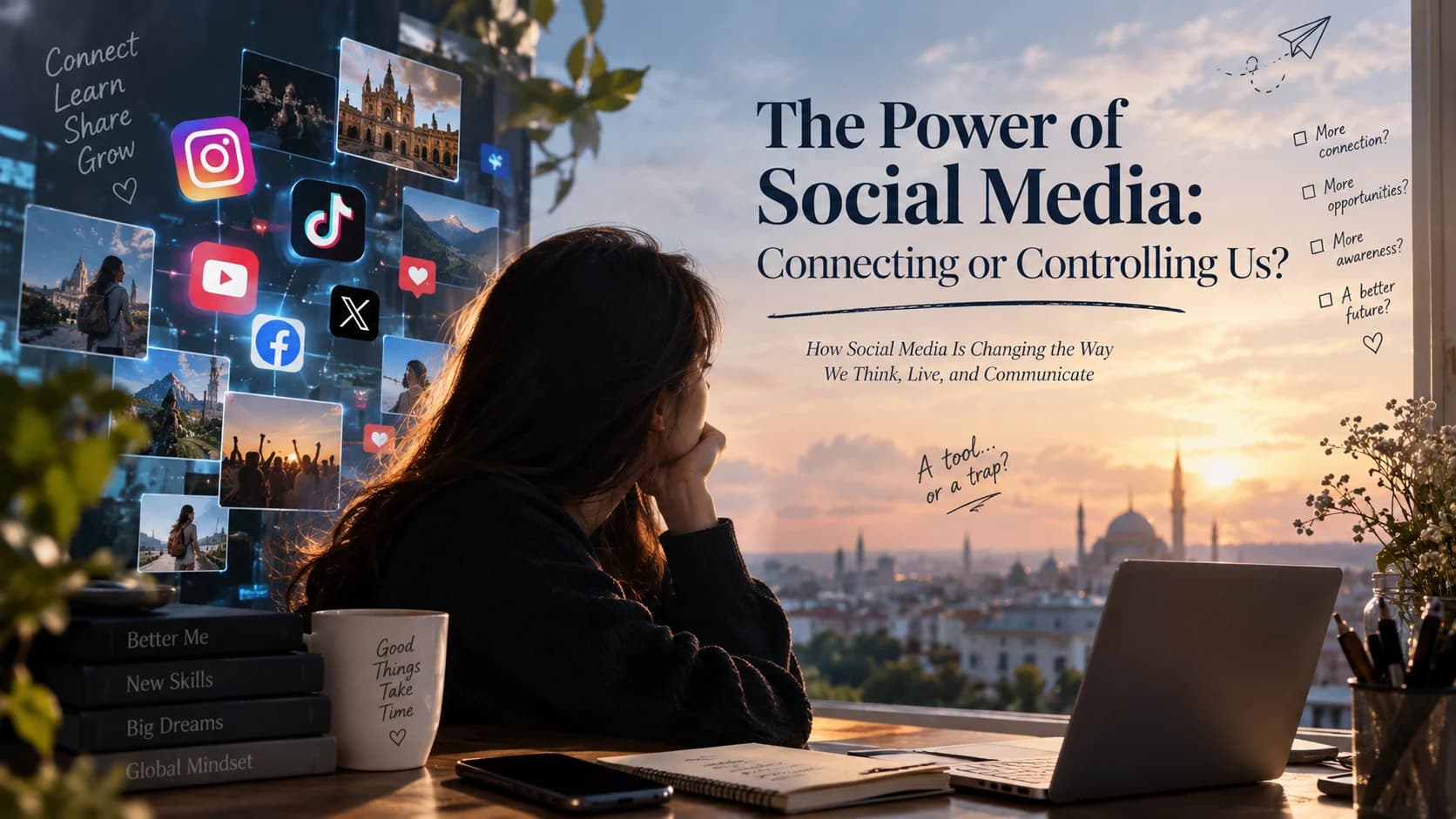
The power of social media:connecting or controlling us
How Social Media Is Changing the Way We Think, Live, and Communicate
Introduction: A World Connected by Screens
Imagine a world where you can communicate with someone thousands of kilometres away in just a few seconds. You can learn a new language, discover different cultures, share your ideas with millions of people, and access knowledge that was once difficult to obtain.
This is the world we live in today.
Social media has transformed the way people communicate, learn, work, and understand the world around them. Platforms such as Instagram, TikTok, Facebook, and YouTube have become more than entertainment tools. They have become spaces where opinions are formed, trends are created, and information spreads across the globe.
Yet, an important question remains: Are we using social media to improve our lives, or are we gradually allowing it to control them?
The answer depends not only on technology itself but also on how consciously we use it.
2. The Positive Power of Social Media
One of the greatest advantages of social media is its ability to connect people beyond geographical and cultural boundaries.
In the past, sharing ideas with a global audience required significant resources and access to traditional media. Today, almost anyone with an internet connection can publish an article, share a creative project, or express an opinion.
Social media has also transformed education. Students can learn foreign languages, explore scientific discoveries, follow international news, and communicate with people from different cultures. Knowledge is no longer limited to classrooms or libraries; it is available through digital platforms to those willing to seek it.
Furthermore, social media creates opportunities for young people to develop their skills, build professional networks, and introduce their ideas to the world.
A single meaningful post can inspire someone to learn a new skill. A thoughtful discussion can challenge an outdated belief. An educational video can open the door to an entirely new field of knowledge.
Social media, when used wisely, is not simply a source of information. It can be a gateway to opportunity.
3. The Hidden Cost of Constant Connection
Despite its advantages, social media has a less positive side.
One of the biggest challenges is the pressure to compare our lives with the lives of others. People often share their achievements, travels, celebrations, and happiest moments online. However, these carefully selected moments rarely represent the full reality of their lives.
When we compare our everyday experiences with someone else's best moments, we may develop unrealistic expectations about success, happiness, and personal achievement.
Another concern is the amount of time people spend scrolling through content without a clear purpose. Minutes can turn into hours, leaving less time for reading, studying, exercising, or having meaningful conversations with family and friends.
The problem is not that social media exists. The problem arises when using it becomes an automatic habit rather than a conscious choice.
We should remember that our attention is valuable. Every hour spent online is an hour that could also be invested in learning, creating, or experiencing the world directly.
4. The Algorithm: Who Controls What We See?
One of the most fascinating aspects of social media is the role of algorithms.
Digital platforms analyse users' interactions, such as the content they watch, like, share, or comment on. This information helps platforms recommend content that is likely to attract their attention.
At first, this seems convenient. We receive recommendations that match our interests, discover relevant information, and find communities with similar ideas.
However, there is a potential problem.
When we repeatedly see content that supports our existing beliefs, we may become less willing to consider different perspectives. Misleading information can also spread rapidly when emotionally engaging content receives widespread attention.
As a result, two people using the same platform may develop very different understandings of the same event.
This is why critical thinking has become an essential skill in the digital age.
Before believing or sharing information, we should ask ourselves three questions:
Is this information supported by reliable evidence?
Who created this content, and what might their purpose be?
Have I checked other trustworthy sources?
In a world where information is everywhere, the ability to think independently is more valuable than ever.
5. Social Media and the Future of Young People
Young people are growing up in a world where digital communication is a natural part of everyday life.
Social media can help them discover their interests, express their creativity, learn new skills, and connect with people who share their ambitions.
At the same time, young users need to develop digital responsibility.
Popularity should not be confused with personal worth. The number of followers does not determine intelligence, talent, kindness, or future success.
Similarly, not every trend deserves attention, and not every online opinion deserves to influence our decisions.
Young people should learn to use digital platforms with a clear purpose: to gain knowledge, develop their abilities, communicate respectfully, and create something meaningful.
Instead of asking only, "How many people will see my post?", we should also ask, "What value does my post bring to others?"
This shift in perspective can transform social media from a source of constant comparison into a platform for genuine growth.
6. From Passive Consumers to Active Creators
There is a significant difference between consuming content and creating it.
A passive user spends hours watching other people's achievements, opinions, and lifestyles. An active creator uses digital platforms to develop ideas, share knowledge, express creativity, and contribute to meaningful conversations.
For example, a student learning English can spend time endlessly scrolling through videos or use social media to practise vocabulary, publish short educational posts, and communicate with other learners.
Both activities take place on the same platforms, but their outcomes can be very different.
The goal is not to eliminate entertainment. Enjoyment is a normal part of life. Rather, the goal is to create a healthy balance between consuming information and producing something valuable.
Do not let the digital world become a place where you only watch others live. Make it a place where you develop your own ideas, skills, and ambitions.
7. Conclusion: The Choice Is Ours
Social media is neither entirely good nor entirely bad. It is a powerful technology whose effects depend on how it is designed, how it is used, and how responsibly people interact with it.
It can educate or mislead, connect or isolate, inspire or distract. It can introduce us to new opportunities while also demanding more of our attention than we intended to give.
We cannot control every development in the digital world, but we can make conscious decisions about how we participate in it.
We can choose reliable information over rumours, meaningful communication over endless scrolling, and personal development over constant comparison.
Ultimately, the most important question is not whether social media has power.
It clearly does.
The real question is whether we have enough awareness to use that power without surrendering our time, our judgement, and our individuality.
Technology should serve humanity, not replace its ability to think, feel, and choose.
The future of social media will be shaped not only by the people who build digital platforms but also by the people who use them every day.
And perhaps the most important digital skill of all is learning when to connect with the world—and when to disconnect from the screen to live in it.
A Final Thought
“In a world competing for your attention, protecting your ability to think independently is an act of freedom.”

Muallif
Maxramova Fariza Faridjonovna
Xitoy tili yo‘nalishi · Pazandalik · Mas’uliyat · Sefr B2 · Jomboy tumani yoshlari