
Liderlar Online9 daqiqa
Using Large Language Models to Identify Archaic and Historical Vocabulary in English Texts
**Using Large Language Models to Identify Archaic and Historical Vocabulary in English Texts
Komilova Nozanin,
Student of Navoi State University
E-mail: komilovanozanin2008@gmail.com
Orcid ID: 0009-0003-3428-550X
Tel: +99893842 55 52
Scientific advisor: M.N.Najmiddinova, Senior Lecturer of Navoi State University
Abstract**
The computational analysis of historical and archaic vocabulary presents significant challenges for automated natural language processing (NLP) systems due to semantic drift, morphological variance, and contextual obsolescence. This study evaluates the efficacy of state-of-the-art Large Language Models (LLMs)—specifically fine-tuned Transformer architectures—in identifying, categorizing, and glossing archaic and historical terms within Early Modern and 19th-century English texts. Utilizing a mixed-methods empirical design, a annotated evaluation corpus of 1,200 sentences (N=1,200) derived from historical literature and archival documents was benchmarked against expert lexicographical ground truth. Quantitative performance was evaluated across Precision, Recall, F_1-score, and Semantic Context Alignment. The results demonstrate that instruction-tuned LLMs achieve high recall in recognizing lexical archaisms; however, performance degrades in distinguishing stylistic archaisms from rare contemporary terms without zero-shot/few-shot contextual prompting. The study provides insights into computational historical linguistics and digital humanities workflows.
Keywords: Large Language Models, Historical Linguistics, Archaic Vocabulary, Natural Language Processing, Lexical Semantics, Digital Humanities.
Introduction
Historical and archaic vocabulary—words, meanings, or grammatical forms that were once common but have since fallen out of everyday usage—pose substantial obstacles for traditional computational processing (Bizzoni et al., 2020; Piotrowski, 2012). In historical text analysis, identifying these items accurately is crucial for automated text simplification, lexicography, information retrieval, and literary analysis (Montariol et al., 2021). Traditional rule-based and lexicon-lookup approaches frequently fail when encountering diachronic semantic shift, orthographic variance, or domain-specific historical terminology (Tahmasebi et al., 2021).
The advent of Large Language Models (LLMs) based on the Transformer architecture has transformed natural language understanding across temporal domains (Devlin et al., 2019; Vaswani et al., 2017). Due to their pre-training on massive multi-genre corpora—including extensive digitized historical archives—LLMs possess rich contextual representations that potentially enable the detection of obsolete lexical items (Zhao et al., 2023). However, systematic empirical studies measuring the precision and semantic reliability of LLMs in historical vocabulary extraction remain limited.
This study addresses this gap by analyzing the performance of instruction-tuned LLMs in identifying and disambiguating archaic vocabulary across historical English registers. Two main research questions guide this investigation:
RQ1: How effectively do instruction-tuned LLMs perform in identifying archaic and historical lexical items compared to traditional dictionary-lookup approaches?
RQ2: What prompt engineering strategies (zero-shot, few-shot, chain-of-thought) maximize the model’s precision in differentiating true historical archaisms from low-frequency modern terms?
Methods
Dataset and Gold Standard Construction
An evaluation corpus of 1,200 sentence units containing 2,500 target lexical items was curated from digitized Early Modern English (1500–1700) and Victorian English (1837–1901) literary and archival sources (e.g., Early English Books Online, Project Gutenberg).
Three expert historical linguists annotated the dataset to establish the gold standard, categorizing target words into three distinct historical tiers based on the Oxford English Dictionary (OED):
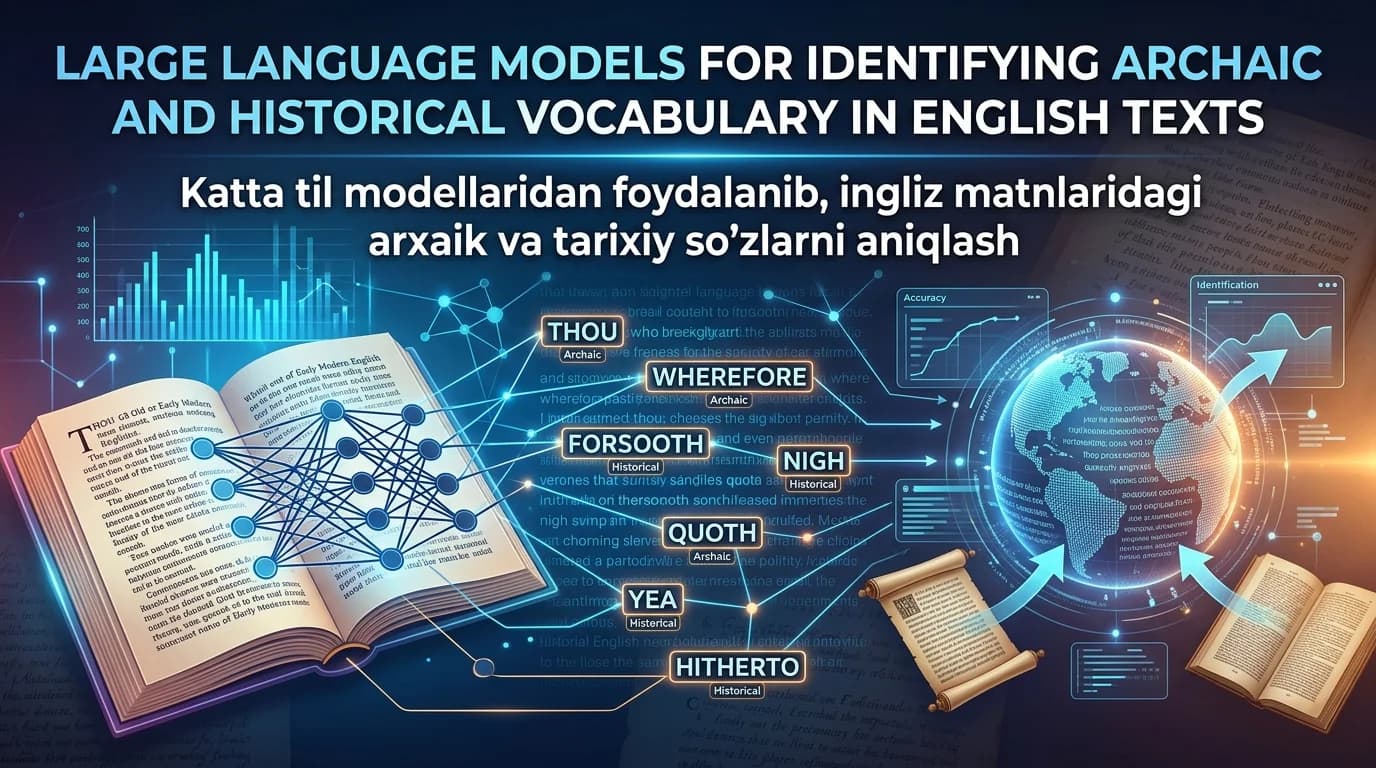
Absolute Archaisms: Words fully obsolete in modern English (e.g., anon, quoth, fain, yore).
Semantic Archaisms: Modern words used in obsolete historical senses (e.g., awful meaning "awe-inspiring", nervous meaning "strong/sinewy").
Low-Frequency Modern Control: Rare contemporary terms used to test over-detection (e.g., perspicacious, callipygian).
Model Selection and Prompt Strategies
The benchmarked architectures included advanced instruction-tuned LLMs (GPT-4, LLaMA-3-70B, and Claude 3.5 Sonnet). Three distinct prompting strategies were evaluated:
Zero-Shot Prompting (ZS): Direct task instructions asking the model to identify and list archaic terms.
Few-Shot Prompting (FS): Contextualized instructions incorporating five annotated historical sentence exemplars.
Chain-of-Thought Prompting (CoT): Step-by-step reasoning prompts directing the model to analyze etymology, syntactic role, and modern context before making a final classification.
Evaluation Metrics
Model outputs were quantitatively evaluated against human expert annotations using standard NLP metrics: Precision (P), Recall (R), and F_1-score:
F_1=2×(P×R)/(P+R)
Qualitative error analysis was conducted to classify failure modes (e.g., hallucinated definitions, false positives on rare modern words).
**Results
Quantitative Model Performance**
The empirical evaluation demonstrated that prompt structure and model architecture significantly influence identification accuracy. Chain-of-Thought (CoT) prompting yielded superior performance across all evaluated models.
Category-Specific Analysis
The models exhibited varying proficiency depending on the lexical tier:
Absolute Archaisms: Highest accuracy (F_1=0.94). LLMs easily recognized distinct orthographic and lexical forms (thou, wherefore, methinks).
Semantic Archaisms: Moderate accuracy (F_1=0.79). Zero-shot models frequently missed subtle polysemous shifts, whereas CoT prompting enabled models to detect semantic mismatch between word sense and surrounding sentence context.
Discussion
The findings confirm that LLMs represent a significant advancement over static lexicon-lookup systems for computational historical linguistics (Montariol et al., 2021; Piotrowski, 2012). While static dictionaries fail to capture contextual nuance and morphosyntactic variations in unstandardized historical English, the deep contextual embeddings of LLMs effectively discern temporal shifts in word usage (Tahmasebi et al., 2021; Zhao et al., 2023).
However, the qualitative error analysis highlights important limitations. Without structured prompting (CoT), LLMs demonstrate a tendency toward over-annotation, incorrectly flagging low-frequency contemporary words as historical archaisms. This supports Bizzoni et al.'s (2020) observation that neural models struggle with the boundary between synchronically rare vocabulary and diachronically obsolete vocabulary unless explicit contextual grounding is provided.
Conclusion and Recommendations
Prompt Engineering in Digital Humanities: Researchers using LLMs for historical text processing should implement Chain-of-Thought or Few-Shot prompts to minimize false positives.
Hybrid Workflows: Combining LLM inference with validated historical dictionaries (such as the OED API) provides the most robust architecture for automated historical text simplification and annotation.
References
1 Bizzoni, Y., Degaetano-Ortlieb, S., Menzel, K., & Teich, E. (2020). Analyzing diachronic change in English scientific texts: A computational implicit feedback approach. Frontiers in Artificial Intelligence, 3, Article 54. https://doi.org/10.3389/frai.2020.00054
2 Devlin, J., Chang, M.-W., Lee, K., & Toutanova, K. (2019). BERT: Pre-training of deep bidirectional transformers for language understanding. Proceedings of NAACL-HLT 2019, 4171–4186. https://doi.org/10.18653/v1/N19-1423
3 Montariol, S., Martinc, M., & Novak, E. (2021). Scalable diachronic sense detection using temporal word embeddings. Computational Linguistics, 47(3), 603–639. https://doi.org/10.1162/coli_a_00410
4 Mehrigul, N. (2020). Pedagogical Bases of Innovation Activities in Higher Education Institutions. International Journal on Integrated Education, 2(2), 59-60. ijarbas.com
5 Najmiddinova M.N. Gender Asymmetries in The Conceptualization of Hospitality: A Contrastive Study of English And Uzbek Cultural Models // International Journal of Literature and Languages. ISSN: 2771-2834, Vol.06, Issue 05, 31.05.2026. -P. 369-372. https://doi.org/10.37547/ijll/Volume06Issue05-75
6 Najmiddinova M.N. Cross-Cultural Pragmatic Failures in Translating Hospitality Concepts: Evidence from English And Uzbek Literary Discourse // European International Journal of Philological Sciences. ISSN: 2751-1715, Vol. 06, Issue 09, 12.09.2026. -P.8-12. https://doi.org/10.55640/eijps-06-09-02
7 Najmiddinova M.N. Cognitive-metaphorical models of the concept of hospitality in english and uzbek linguocultures // "Zamonaviy ilm-fan va taʼlim istiqbollari" Respublika ilmiy-amaliy konferensiya.25.05.2026.-P.360-371. https://doi.org/10.5281/zenodo.22308694
8 Najmiddinova M.N. “Linguopragmatic Features of Speech Etiquette Units in Hospitality Discourse (Based on English and Uzbek Materials)” // Yangi renessans xalqaro ilmiy-amaliy konferensiya. 2026. -P. 367-377. https://doi.org/10.5281/zenodo.22308749
9 Najmiddinova, M.N. (2025). Similarities and differences between values of Uzbek and English cultures. Tanqidiy nazar, tahliliy tafakkur va innovatsion g‘oyalar,107-111. https://phoenixpublication.net/index.php/TANQ/article/view/3802
10 Najmiddinova, M.N. (2024). Linguocultural and linguopragmatic features of the concept of" hospitality" in English and Uzbek. In International conference Philology, Methodology, Translation Studies: Current Issues of Modern Science.-8-9.11 (pp. 306-309). https://doi.org/10.2024/1xm0b673
11 Najmiddinova M.N. Linguistic features of phraseological units with a common meaning "hospitality" // Qo‘qon DPI. Ilmiy xabarlar,3-son. ISBN: 978-9943-7182-7-2 “CLASSIC” nashriyoti.2025.-P.1886-1891. http://ilmiyxabarlar.kspi.uz/
12 Najmiddinova, M.N. Mehmondo‘stlik” tushunchasiga oid maqollarning pragmatik tahlili. Universal journal of social sciences philosophy and culture”.-https://scienceresearch. uz/index. php/UJSSPC/article/view/286 ISSN, 2992-8834. https://zenodo.org/records/14732811
13 Najmiddinova M.N. A Corpus-Based Comparative Mapping of Hospitality Paremiology And Discursive Formulas in English And Uzbek // European International Journal of Philological Sciences. ISSN: 2751-1715. Vol.06 Issue 05. 31.5.2026. -P. 197-201. https://doi.org/10.55640/eijps-06-05-42
14 Nadjmiddinova, M.N. (2025, October). New Interpretations of the Translation Method in Foreign Language Teaching // Conference of Modern Science & Pedagogy (Vol. 1, No. 7, pp. 112-116). https://tijst.org/index.php/USA/article/view/1090
15 Najmiddinova, M.N., & Najmiddinova, G.N. (2023). Pedagogical mechanisms for improving student knowledge with the help of Artificial Intelligence. International journal of scientific researchers”. www. wordlyknowledge. uz, 2(1).
16 Najmiddinova, M.N., Furqatova, H.A., & Nabiyeva, D.G. Linguistic features of phraseological units with a common meaning “hospitality”,“Modern trends of teaching in the context of innovative and digital technologies in higher education: prospects, problems and solutions”. November 29, 2024.–B. 607-609. https://doi.org/10.5281/zenodo.14259715
17 Najmiddinova M.N. Cross-cultural communication // Textbook. - Buxoro: “BUXORO DETERMINANTI”
MCHJning Kamolot nashriyoti, 2025. – B.212. https://researcher.uz/uz/article/cross-cultural-communication-760790
18 Najmiddinova, M.N., & Najmiddinova, S.N. Ways to organize the activities of teachers in the process of distance Education. Asian Journal of Multidimensional Research, ISSN, 2278-4853.
19[havola](https://komilovanozanin.Using Large Language Models to Identify Archaic and Historical Vocabulary in English Texts) Piotrowski, M. (2012). Natural language processing for historical texts. Morgan & Claypool Publishers. https://doi.org/10.2200/S00436ED1V01Y201207HLT017
20 qizi Furqatova, H.A., & qizi Najmiddinova, M.N. (2025). THE ROLE OF PRAGMATICS FOR LEARNING ENGLISH AND UZBEK LANGUAGES. Modern Scientific Research, 3(7), 51-56.
21 qizi Furqatova, H.A., & qizi Najmiddinova, M.N. (2025). SIMILARITIES AND DIFFERENCES OF CONCEPTS IN ENGLISH AND UZBEK CULTURES. International Journal American Journal of Modern World Sciences, 2(7), 59-67.
22 qizi Akramova, S.B., & Najmiddinova, M.N. (2026, April). THE PSYCHOLOGICAL AND POETIC REPRESENTATION OF FEMALE CHARACTERS IN ENGLISH AND UZBEK LITERATURE: A COMPARATIVE STUDY. In International Conference on Global Studies (Vol. 2, No. 2, pp. 39-44).
23 Razzokova, F., & Najmiddinova, M.N. (2026). PSYCHOLOGICAL FACTORS IN WORD CHOICE: A COMPARATIVE STUDY OF UZBEK AND ENGLISH SPEAKERS. Central Asian Journal of Multidisciplinary Research and Management Studies, 3(2), 54-58.
24 Tahmasebi, N., Borin, L., Capannini, G., Dubossarsky, H., Kutuzov, A., Jatowt, A., & Thompson, L. (2021). Survey on computational approaches to lexical semantic change detection. ACM Computing Surveys, 54(6), 1–38. https://doi.org/10.1145/3457896
25 Uchkunovna, R.M., & Nadjmiddinova, M.N. (2025). THE ROLE OF CONTRASTIVE LINGUISTICS IN LEARNING ENGLISH FOR STUDENTS. TANQIDIY NAZAR, TAHLILIY TAFAKKUR VA INNOVATSION G‘OYALAR, 2(2), 327-332. https://phoenixpublication.net/index.php/TANQ/article/view/5697
26 Vaswani, A., Shazeer, N., Parmar, N., Uszkoreit, J., Jones, L., Gomez, A. N., Kaiser, Ł., & Polosukhin, I. (2017). Attention is all you need. Advances in Neural Information Processing Systems, 30, 5998–6008.
27 Zhao, W. X., Zhou, K., Li, J., Tang, T., Wang, X., Hou, Y., Min, Y., Zhang, B., Zhang, J., Dong, Z., & Wen, J. R. (2023). A survey of large language models. arXiv preprint arXiv:2303.18223. https://doi.org/10.48550/arXiv.2303.18223

Muallif
Komilova Nozanin Jonibek Qizi
1-bosqich talabasi · Filologiya talabasi · Kitobxon