
Ensiklopediya4 daqiqa
THE IMPACT OF SOCIAL MEDIA ON STUDENTS’ ACADEMIC PERFORMANCES
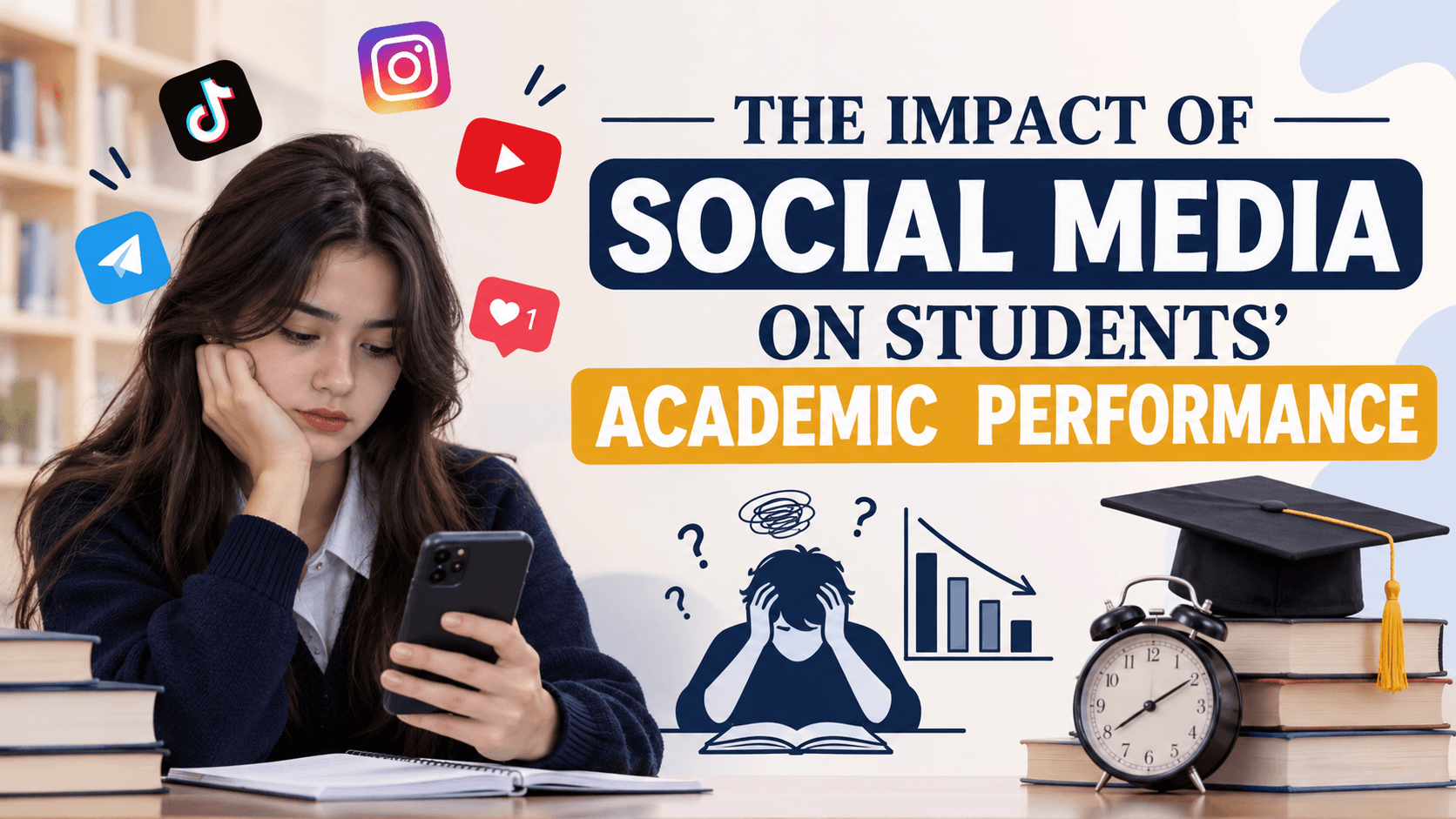
Social media has transformed the ways in which students communicate, exchange information and participate in educational activities. Platforms that enable messaging, content sharing, group discussions and video communication are widely used in students’ academic and personal lives. These platforms can provide convenient opportunities to exchange learning materials, ask maintain contact with classmates outside the classroom.
Despite these potential benefits, concerns have emerged about the relationship between social media use and academic performance. Students may encounter frequent notifications, entertainment content, and social interactions while completing academic tasks. Switching repeatedly between studying and social medial may interrupt concentration and make it more difficult to maintain attention on demanding assignments. Time spent on social networking platforms may also compete with time available for recording, revision, and independent learning. Previous research has not produced a completely uniform picture of this relationship. Some studies have identified negative associations between social networking use and academic achievement, whereas others indicate that particular online activities may be associated with beneficial educational outcomes. These differences suggest that the impact of social media depends not only on whether students use these platforms, but also on how, why and when use them.
Huang (2018), in a meta-analysis of 30 studies involving 21,367 participants, reported a small negative overall correlation between social networking site use and academic achievement. Liu et al (2017) also identified a negative relationship in their meta-analysis, although the findings varied according to the type of academic outcome examined. Such results demonstrate the importance of examining the relationship carefully rather than assuming that social media is uniformly beneficial or harmful.
Academic performance can be measured in several ways, including examination scores, course grades, grade point average, assignment results and broader indicators of academic achievement. Social media use is equally varied: it may involve academic discussions, sharing educational materials, communicating with classmates, entertainment, or general social interaction. These differences matter because the relationship between social media and academic performance may depend on the specific activities being measured. Liu et al. (2017) conducted a meta-analysis examining the relationship between social networking site use and academic performance among adolescents and young adults. Their analysis included 28 effect sizes from a combined sample of 101,441 participants. The authors reported a negative relationship between social networking site use and academic performance, but the findings differed across academic outcomes. The relationship with grade point average was negative, whereas the relationship with language-test performance was positive. These findings are important for two reasons. First, they suggest that greater social networking use may be associated with slightly lower academic achievement on average. Second, the relatively small associations indicate that social media use alone is unlikely to explain the full variation in students’ academic performance. Academic performance is influenced by multiple factors, including prior knowledge, motivation, study strategies, access to learning resources and personal circumstances. Therefore, the observed association between social media use and academic performance should not automatically be interpreted as proof that social media directly causes lower grades.
One potential explanation for a negative association is distraction. Social media platforms provide a continuous stream of messages, updates and other content that can compete academic tasks for student’ attention. When students check information while reading or completing assignments, they may interrupt the mental processes required to understand and remember information.
Social media has a complex relationship with students’ academic performance. Existing research suggests that overall social networking site use may be associated with a small negative relationship with academic achievement, but the strength and direction of this relationship vary according to the type of activity and the academic outcome measured. Potential risks include distraction, interrupted concentration, multitasking, and reduced time for academic work. At the same time, purposeful use may support access to educational information and collaboration. These contrasting possibilities indicate that social media should not be treated as inherently harmful or automatically beneficial to learning.
The central implication is that the academic impact of social media depends partly on how students integrate it into their study routines. Students, educators and researchers should pay attention to the purpose, timing and context of use rather than relying solely on total time spent online. A more detailed and up-to-date evidence base is needed to identify which patterns of social media use are most closely associated with successful learning.